
Polyglot: A Multilingual Compliance Platform Fleet Built on Nick
A Swedish platform company runs nine independent Nick + Volto sites on one EU-hosted server — public customer sites, an artist portfolio, and private compliance workspaces for manufacturers entering the EU market — the first of a fleet designed to serve thousands, on a 71-language translation corpus that was merged into Nick itself in June 2026.
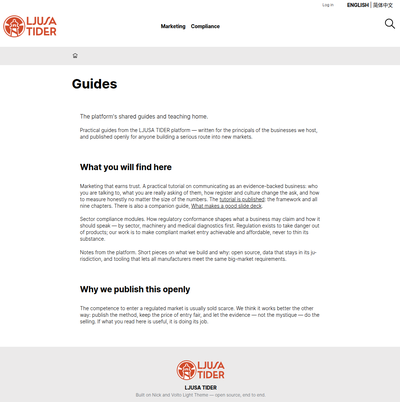
When safety information has to be right in every official language of every market where a product is sold, a website stops being marketing and becomes regulatory infrastructure. In Sweden, a platform company has spent the past year building exactly that on Nick — Plone's headless, PostgreSQL-backed sibling — and running it in production as a fleet of nine independent sites on a single host, from public customer sites to private workspaces for manufacturers entering the EU market. Nine is the beginning, not the point: the architecture's unit of growth is one more tenant, and it is designed to carry thousands.
At a glance
- Project: Polyglot — a multilingual compliance and content platform, and the multi-tenant fleet built on it. https://ljusa-tider.se/en
- Sector: EU market access and regulated documentation for imported products; multilingual content infrastructure
- Technology: Nick (Node.js/Express, PostgreSQL 16), Volto 19 with volto-light-theme, self-hosted Forgejo, nginx, EU-hosted infrastructure
- Scale (August 2026): 9 independent Nick + Volto stacks on one host, one isolated database per site; a translation corpus of 71 languages and 350,000+ translations; more than 2,800 controlled documents governing the platform itself
- Community footprint: the Polyglot translation corpus was merged into Nick through the Plone release team in June 2026 (118 files); engagement since late 2024 has produced more than sixty technical reports and eight patches across Nick, Volto, and volto-light-theme (many fixed upstream), code contributions merged into Nick, 36 per-language translation reviews for Plone and Volto, installation and overview documentation integrated into Nick's official docs, and a Plone style-guide PLIP
The challenge
EU regulation — MDR, IVDR, the Machinery Regulation, the General Product Safety Regulation — requires that safety-critical information such as instructions for use, labels, and safety notices be supplied in the official language of every member state where a product is placed on the market. Up to 23 languages, each carrying legal liability. A mistranslated safety warning is not a cosmetic defect, and a mistranslated submission is rejected by the notified body.
EU regulation does not scale with company size: a two-person importer carries the same language obligations as a multinational — the law treats them equally. What differs is the infrastructure each can bring to bear. The platform's premise is that the same grade of compliance infrastructure — websites, documentation workspaces, and compliance surfaces that treat multilingual precision, auditability, and data sovereignty as native properties, not features bolted on later — should enable them equally. And the platform serving them has to be trustworthy in the same way: if the infrastructure will one day carry accredited compliance work, its own construction has to survive an audit.
Why Nick
Nick carries Plone's twenty years of content-model maturity — structured types, workflows, granular permissions, versioning, relations, multilingual translation groups — into a lean Node.js service backed entirely by PostgreSQL, speaking the same REST API that Volto already understands.
For this platform, that combination was decisive:
- The Plone content model, queryable in SQL. Nick stores everything in PostgreSQL rather than an object database: every content object, version, permission, and workflow state is a row that audit triggers, integrity constraints, and evidence queries attach to directly — and that standard database tooling backs up, replicates, and federates. For a compliance platform, the database is the audit surface.
- A codebase small enough to audit. A platform that promises auditable compliance has to be able to read its own foundation. Nick's surface is small enough that the team actually reads the routes it depends on, keeps its deployment clean and current, and files fixes upstream — twenty years of Plone experience, without twenty years of accumulated luggage.
- One language, one codebase culture, front to back. TypeScript on the server, TypeScript in Volto: one skill set carries the whole stack, and the same people can work either side of the API.
- plone.restapi compatibility. Volto — and volto-light-theme — work out of the box. The fleet's editors get the modern Plone editing experience; the platform gets the Plone ecosystem's frontend, and content stays portable in both directions.
- Built by Plone's own core developers, stewarded in the Plone GitHub organization. Nick distills two decades of Plone insight, and its home in the Plone community means no single-maintainer risk. The relationship runs both ways in practice: the engagement has returned more than sixty upstream reports and eight patches with fixes landing upstream, code contributions are merged into Nick's codebase, the entire Polyglot corpus is part of Nick itself — and the platform's operator is a member of the Nick team, so there is no daylight between user and upstream.
- Security inherited, then proven. Nick carries Plone's permission and workflow security model, with a far smaller attack surface. A younger codebase earns trust through evidence rather than tenure — which is exactly what this platform's audit discipline is for: security review, hardened deployment, and production scrutiny that reports what it finds upstream.
- Light enough to run a fleet. A full Nick + Volto stack per site, nine times over, fits comfortably on one modest EU-hosted server — with per-site isolation an auditor can verify by listing databases and services, rather than trusting row-level policy.
- Open source, self-hostable, jurisdiction-neutral. The entire chain — Nick, Volto, PostgreSQL, Forgejo, nginx — runs on EU infrastructure with no dependency that any one jurisdiction can switch off. For customers whose data must stay in a particular jurisdiction, the same pattern can be cloned to a host in that jurisdiction; the architecture federates rather than centralizes.
The solution
The platform is a fleet of nine independent Nick + Volto stacks behind one nginx edge: each site has its own Nick service, its own Volto service, its own PostgreSQL database, its own TLS certificate, and its own users. Nothing is shared at runtime between sites — a property chosen deliberately for auditability, and one that Nick's small footprint makes affordable.
The fleet today spans the whole spectrum of what the platform is for: Vilax (vilax.ljusa-tider.se), a furniture manufacturer's multilingual exhibition site in 30+ languages with a custom full-bleed frontend; ARCAB (arcab.ljusa-tider.se), the public site of an industrial supplier of armoured cables and coiled tubing, serving 31 languages from a lean Volto addon; Plate to Paper (platetopaper.ljusa-tider.se), an artist's trilingual portfolio with gallery-first design; a public commons of editor tutorials; an internal administration site — and, in private pre-launch, working compliance workspaces for manufacturers entering the EU market in regulated sectors (in-vitro diagnostics and CE-marked machinery), where requirements, evidence, and translated content are assembled before anything goes public.
Underneath them all sits Polyglot, the multilingual foundation: a PostgreSQL-native translation corpus of 71 languages and more than 350,000 translations, with canonical English sources, preserved-terminology and agreed-terminology registers, per-change audit trails, and quality-control workflows including a meaning-drift detector built on locally-run embedding models — because structural checks cannot see a translation that quietly says something its source does not. The corpus is not private infrastructure: it was merged into Nick itself through the Plone release team in June 2026, and the same pipeline feeds the fleet's user interfaces.
Site provisioning is fully typed and repeatable: DNS, database, backend install, frontend scaffold, build, service, and TLS edge each run as audited tooling with post-condition verification, taking a new site from nothing to a live, certificate-bearing deployment in well under an hour — with the seeded admin credential rotated before the site is ever publicly reachable.
What makes this project unique
The platform governs its own development. More than 2,800 controlled documents — design records, bug reports, standard operating procedures, corrective and preventive actions, security audits — live in git, are imported into the platform's own knowledge base, and are served through Nick with database-enforced document control: version bumps and change records are required by triggers, not by convention. The process is the product: before the platform carries anyone else's accredited compliance work, it is its own first compliance case.
AI held to human discipline. The platform is built in close collaboration with AI tooling — under a written rule that AI work meets the same standard as a human developer's: everything auditable, every change documented before deployment, and the assistant's own procedural failures recorded and remediated like any other nonconformity. The language models involved run on local hardware, never on the production server — on a regulated platform, enabling AI endpoints is a significant change, so the architecture keeps them out.
Multilingualism as infrastructure, upstream and down. The same corpus that translates the fleet's interfaces is now part of Nick and available to Plone — a rare case of a production platform's core asset flowing back into the community as a first-class contribution.
Results
- Nine production Nick sites on one EU-hosted server in the first year — with an architecture whose unit of growth is one more tenant, designed to carry thousands of sites without changing shape (per-site isolation, federation rather than centralization)
- Operated by a single-person company with AI assistance held to audit discipline — a measure of how light the stack runs, not of the ambition
- 71 languages, 350,000+ translations, upstream in Nick since June 2026
- New sites live in under an hour via typed, audited provisioning
- Sustained upstream engagement: 60+ technical reports and 8 patches across Nick, Volto, and volto-light-theme with fixes landing upstream, merged code contributions, 36 per-language translation reviews for Plone and Volto, documentation now in Nick's official docs, and a Plone style-guide PLIP — the fleet operator finds the bugs before Nick's wider adoption does
- A documented, database-enforced quality system with 2,800+ controlled records — the platform's accreditation-readiness story, built by using it
About the service provider
The platform is owned and operated by LJUSA TIDER AB (Sweden), founded by Mack Palomäki — a serial entrepreneur with three patents in multi-stakeholder trust infrastructure and a career spanning GSM-era mobile systems, mobile payments, RFID with Sony, laboratory operations, and furniture-industry compliance, alongside Nordic and international standards work. This platform applies the same trust architecture to EU market access. Contact: mack@ljusa-tider.se.