
University of Bonn
How Plone grows with a world-class German university
300+ portals, 4,500 editors, and a long-term commitment to open source — the Rheinische Friedrich-Wilhelms-Universität Bonn has built its entire web presence on Plone, and kept building.
Client
Rheinische Friedrich-Wilhelms-Universität Bonn, Germany
Sector
Higher Education / Research
Audience
32,000 students · 4,500+ editorial users · 800 local administrators
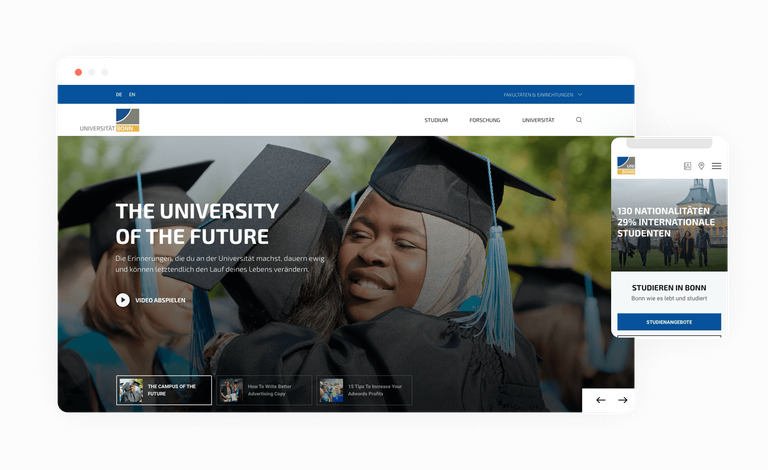
The challenge: One platform for an entire university
The University of Bonn — home to six Excellence Initiative clusters, more than any other German university — operates over 300 individual web portals for its central site, faculties, institutes, and research groups, each with distinct editorial teams, structures, and requirements.
When the university's legacy infrastructure reached end-of-life, the challenge went beyond a technical migration. It meant redesigning the editorial experience for thousands of editors across a highly decentralised organisation, without disrupting the daily work of an active research university.
Why Plone? Open source built for institutions that think long-term
For a publicly funded university, open-source independence is not a preference — it is a requirement. Plone's multi-site architecture, fine-grained permission model, and long-term stability made it the right foundation.
The University of Bonn has run Plone through multiple major versions — from early Plone deployments on Plone 3 through Plone 5 to today's Plone 6 Classic UI — always staying on the current release. That upgrade continuity, without ever needing to replatform, is itself a strong argument for the technology.
The solution:
Plone 6 Classic UI with the Interaktiv Tiles Editor
Interaktiv took over as the university's primary Plone partner in 2018, delivering a design and architecture relaunch across all portals. Today the platform runs on Plone 6 Classic UI, extended by the Interaktiv Tiles Editor — a content editing environment developed and refined over eight years for this specific heterogeneous, decentralised editorial context.
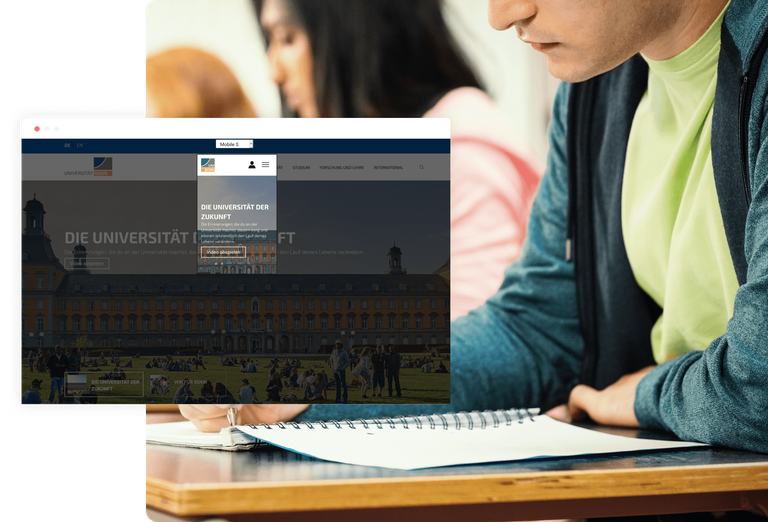
Editors across all faculties and institutes can build and manage complete pages using drag-and-drop page assembly, reusable block-level templates, and granular role and permissions management — down to individual block types. The system supports full German/English multilingual content, custom tiles for locations, contacts, and galleries, and desktop/mobile preview before publishing.
The infrastructure runs across ~20 virtualised servers, with RADIUS/LDAP authentication, Varnish caching, and Puppet-managed configuration — hosted in Germany throughout.
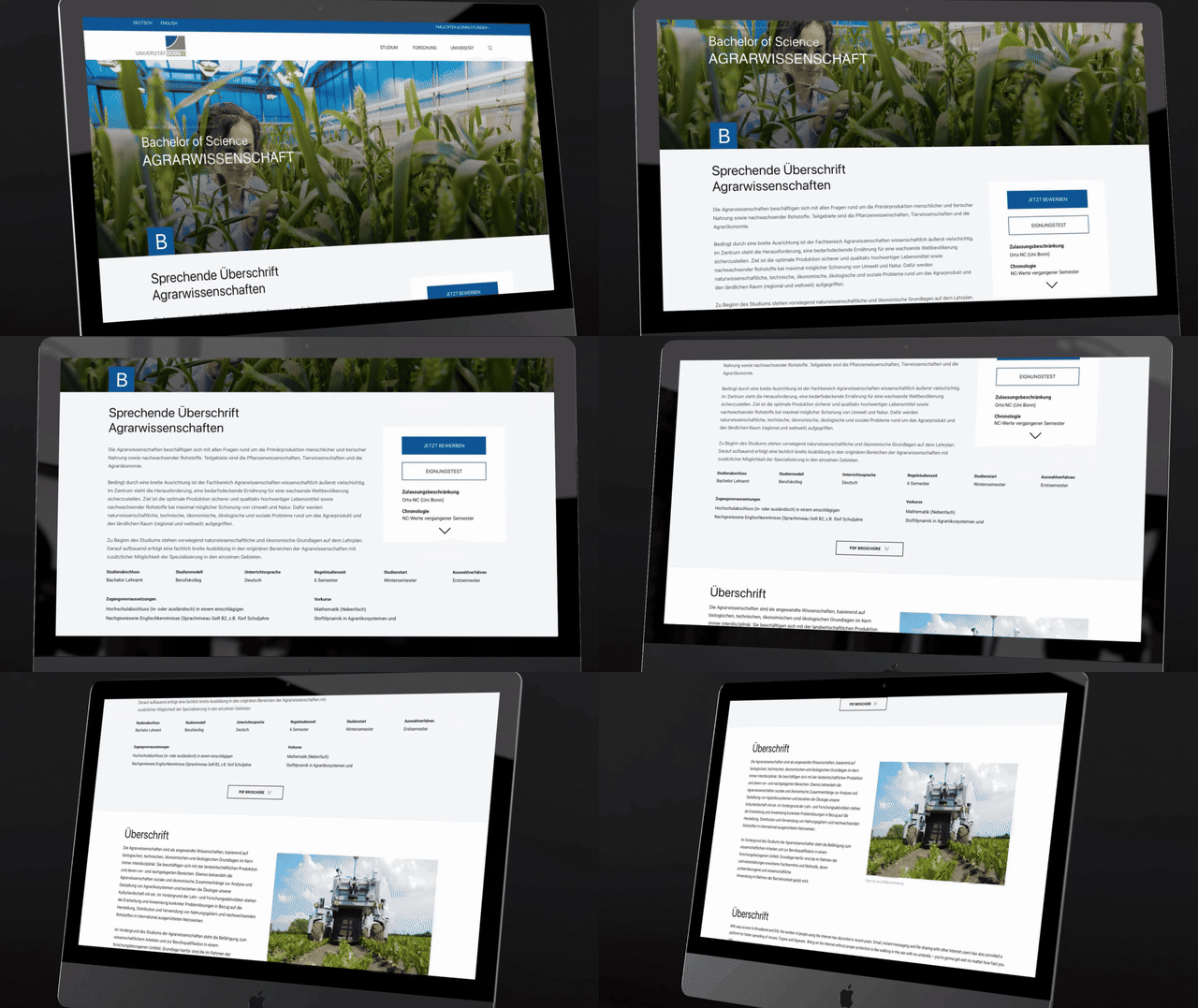
Migration: Iterative, parallel, continuous
The legacy infrastructure — heterogeneous across 300 portals accumulated over many years — was replaced incrementally, with legacy and new portals running in parallel throughout. Interaktiv led the full process: content analysis, information architecture, UX design (Figma, personas, user journeys, prototypes), phased portal rollout, and editor training across the organisation.
The approach was designed to keep the university operational at every stage, with continuous stakeholder feedback loops and no big-bang cutovers.
A platform in continuous development
What began as a migration project has become a continuously evolving platform. The most recent addition illustrates where the partnership is heading: an AI-powered study counselling chatbot, developed jointly with the University of Bonn's Computing Centre .
Rather than relying on a proprietary cloud model, the system uses open-weight language models deployed on-premise within the university's own infrastructure. Retrieval-Augmented Generation (RAG) grounds responses in curated institutional data — programme descriptions, examination regulations, module handbooks, official web content — with paragraph-level citations making every answer traceable. Fallback strategies escalate to human advisors when queries exceed defined boundaries.
The system is GDPR-compliant by design, free from US-based cloud dependencies, and built to be institutionally accountable. A paper co-authored by Jörg Zell (Interaktiv) and Martin Ragg (HRZ, University of Bonn), "Sovereign by Design: Building a Factual, Open-Source AI Chatbot for University Student Advisory Services," was presented at EDULEARN26 in June 2026.
Compliance
Accessibility (BITV 2.0 / WCAG)
Independently audited; accessibility considered for both frontend and editorial backend
GDPR/DSGVO
Including the AI chatbot, designed data-protection-first from the outset
Hosted in Germany
Data sovereignty for a public institution throughout
Provider information
Based in the Cologne region, Interaktiv is the largest Plone agency in the DACH region, with over two decades of expertise in complex web platforms for universities, government institutions, and large organisations. Their 26-member team combines design thinking, lean UX methodology, and deep Plone expertise to deliver platforms built for the long term.
Interaktiv GmbH, Germany Website: www.interaktiv.de